

Company News, Deals

In this article, we explore how debt financing is influencing UK mid‑market M&A. We elaborate on why understanding the current lending landscape has become essential for owner‑managed businesses considering a transaction. Debt financing involves using borrowed funds to support an acquisition, with repayments made from the future cash flows of the business rather than through dilution of ownership.
The landscape has shifted in recent years. Securing the right debt is now as much about preparation, structure and lender alignment as it is about cost. We outline the key trends shaping today’s market and highlight the practical considerations business owners should keep in mind as they plan their next steps.
Debt is no longer just about price in the UK mid-market, it’s about certainty, speed and structure. For owner-managed businesses, understanding the new dynamics can mean the difference between a deal that gets done and one that doesn’t.
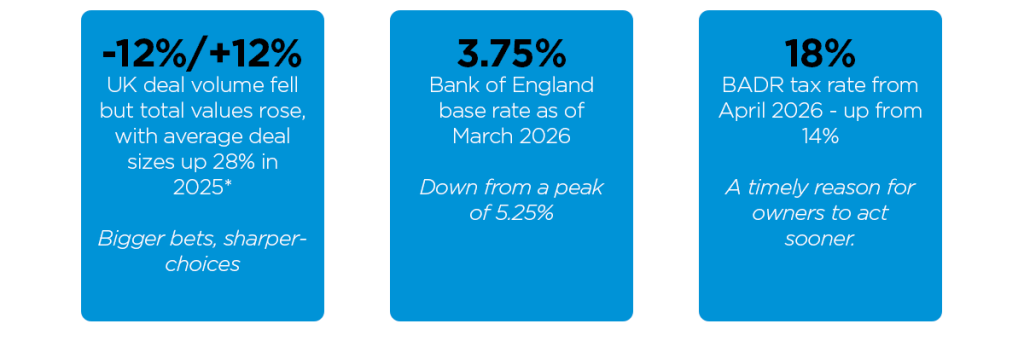
2025 was a year of recalibration. Elevated financing costs, the Capital Gains Tax (CGT) and National Insurance Contribution (NIC) increases from the Autumn Budget 2024 and persistent inflation all weighed on UK mid-market deal activity.
Volumes fell by around 12% in 2025. But the headline masks something interesting in deal dynamics. Total deal values rose 12% over the same period, when buyers transacted, they committed with conviction. The market didn’t necessarily slow down but instead became more selective.
2026 looks more encouraging. The Bank of England has cut its base rate from a peak of 5.25% to 3.75%, confidence is returning, with more sales coming to market. The doors aren’t thrown wide open, but they’re opening, for the right businesses.
The most significant structural shift in acquisition finance has been the rise of private credit. Non-bank lenders, such as specialist debt funds, direct lending platforms and challenger banks, now dominate mid-market leveraged finance, with around 70% of private credit transactions carried out to support M&A activity. The competition among lenders is no longer just about price; it’s about flexibility, structure and speed of execution.
Crucially, these lenders are often willing to back a business on the basis of its recurring revenues and management quality. Rather than purely its tangible assets, making deals viable that traditional banks would decline.
Unitranche structures are now widely used. They combine what was once separate senior and junior loans into a single, blended facility, making deals simpler and more certain to execute. There is genuine capital looking for a home, and increasingly it is finding its way into the mid-market.
Better access to debt doesn’t mean less scrutiny, quite the opposite. It is no longer enough to show healthy EBITDA, lenders want to understand how reliably that profit converts into actual cash. Cash conversion, working capital discipline and earnings quality are all under the microscope. EBITDA adjustments are examined closely, exceptional items are capped tightly, and downside scenarios are stress-tested more aggressively than they were even two years ago.
Financial covenants such as leverage tests and debt service cover ratios are back as standard after the covenant-lite era. For owner-managed businesses, the practical implication is clear. Well-presented financials, clearly articulated earnings and demonstrable cash generation are now deal-critical. Preparation isn’t the boring bit before the deal. It’s half the deal.
Lender appetite varies significantly by sector. Technology-enabled services, healthcare, professional services and specialist business services attract strong interest and competitive terms, as businesses with resilient, recurring revenues are in high demand. This makes cybersecurity and AI-adjacent businesses particularly sought after. Highly cyclical or consumer-sensitive businesses, meanwhile, may find debt harder or more expensive to secure. Sector positioning, and the ability to articulate a credible, resilient investment case, has become a meaningful part of achieving the right financing on the right terms.
Earn-outs, deferred consideration and vendor loan notes are all more prevalent than they were, helping bridge valuation gaps where upfront leverage is constrained. Buy-and-build strategies continue to dominate private equity activity, and for businesses being acquired as part of a consolidation platform, understanding the pre-agreed debt facility shaping that process is important context for any seller.
Business Asset Disposal Relief (BADR) now attracts a tax rate of 18% (up from 14%), a meaningful difference in net proceeds for many owners. A timely prompt to consider strategic options. The debt markets are more navigable than they were twelve months ago. But they reward preparation: knowing which lenders are active, how to structure the deal and how to present your business in its best light.
At PEM we support owner‑managed businesses across Cambridge and beyond through all stages of the transaction lifecycle. Our approach combines practical insight with hands-on transactional experience.
If you’re considering a sale, acquisition or strategic investment, and would like to understand how debt financing could impact your transaction, we’d welcome a confidential conversation.
*Source: PwC
From 6 April 2027, most unused pension funds will be included as part of your estate for Inheritance Tax (IHT) purposes.
For many years, pension funds have generally been outside an individual’s estate when calculating IHT. The Government has announced that this will change, meaning many pension funds may become subject to IHT on death.
For some individuals, these changes could significantly increase the amount of tax payable on death and reduce the value ultimately inherited by their beneficiaries.
In some circumstances, pension funds may be subject to:
Depending on the circumstances, the combined tax burden could be substantial.
Historically, many people have chosen to preserve their pension funds for as long as possible and use other assets first, as pensions have generally been outside the scope of IHT. Once the new rules take effect, this approach may no longer be the most tax-efficient strategy.
Including pension funds within your estate may increase your exposure to IHT and reduce the amount passed on to future generations.
There are two key ways in which this could affect your family:
Unless pension benefits pass to a surviving spouse, civil partner or qualifying charity, your pension fund may be subject to IHT.
The IHT liability will generally be settled before beneficiaries receive the remaining pension benefits.
In addition, if you die aged 75 or over, beneficiaries will usually pay income tax when they draw funds from the inherited pension. The amount of tax will depend on their personal circumstances and other income at the time. Worst case is income tax rates on any funds drawn from the inherited pension of 45%.
As a result, the overall tax cost on pension funds can be significant (up to 67%).
The new rules are also expected to increase the administrative burden on executors, personal representatives and pension providers.
Bringing pension funds into your estate may not only create an IHT charge on the pension itself but could also reduce or eliminate other reliefs and allowances (such as the Residence Nil Rate Band RNRB) that would otherwise be available. This could further increase your IHT liability.
The example below illustrates how this could happen.
Anna is widowed and aged 80. Her late husband left his entire estate to her, meaning no IHT was payable on his death. Anna intends to leave her estate equally between her two sons. Her assets are:
| Assets | Value (£) |
| Home | 1,000,000 |
| Cash and shares | 600,000 |
| ISAs | 385,000 |
| Pension pot | 900,000 |
| Total | 2,885,000 |
| Assets | (£) |
| Home | 1,000,000 |
| Cash and shares | 600,000 |
| ISAs | 385,000 |
| Gross taxable estate | 1,985,000 |
| Residence nil-rate band* | (350,000) |
| Nil-rate band* | (650,000) |
| Chargeable estate | 985,000 |
| IHT 40% | 394,000 |
* Assumes full transfer of Anna’s late husband’s unused Nil Rate Band and Residence Nil Rate Band.
| Assets | (£) |
| Home | 1,000,000 |
| Cash and shares | 600,000 |
| ISAs | 385,000 |
| Pension pot | 900,000 |
| Gross taxable estate | 2,885,000 |
| Residence nil-rate band** | (nil) |
| Nil-rate band | (650,000) |
| Chargeable estate | 2,235,000 |
| IHT 40% | 894,000 |
**The estate exceeds £2.7 million, resulting in the complete loss of the Residence Nil Rate Band.
In this example, there is an increase in the IHT liability by £500,000. This comprises:
Given the potential impact of these changes, we recommend reviewing your current estate planning arrangements and estimated IHT position.
Understanding the value of your pension funds and how they may affect your overall estate from April 2027 will help identify whether additional planning should be considered.
Once we have assessed your circumstances, we can discuss the options available and whether steps can be taken to reduce the potential tax burden for your family.
If you would like to discuss how these changes may affect you, please get in touch with our Private Clients team.
Please note that this content is not intended to give specific technical advice. It is designed to highlight some of the key changes rather than provide an exhaustive explanation of the topics. Professional advice should always be sought before action is either taken or refrained from as a result of information contained herein.
James graduated from Loughborough University in 2016 with a degree in Business, Economics & Finance. Following his passion for finance, he pursued the ACA qualification and became a Chartered Accountant in 2020, training at a regional firm of accountants based in Norfolk.